

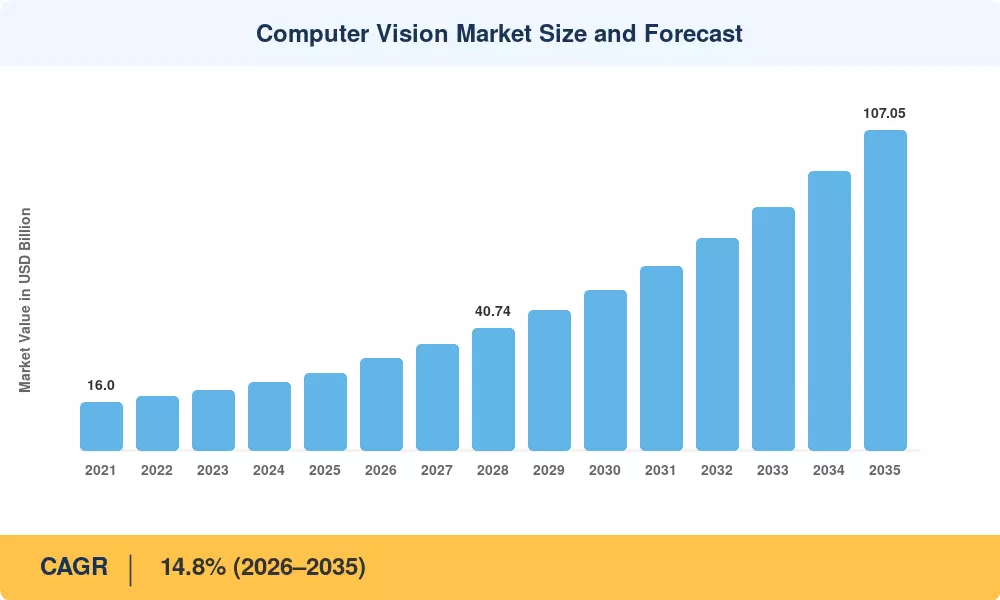
Computer Vision Market to Surge at 14.8% CAGR, Anticipated to Reach USD 107.05 Billion by 2035
Computer Vision Market
Computer Vision enables intelligent image and video analysis, driving automation, accuracy, security, and innovation across industries.
Computer vision is transforming industries through intelligent image recognition, automation, and real-time visual analytics.”
NEW YORK(NY), NY, UNITED STATES, September 4, 2026 /EINPresswire.com/ -- The Computer Vision Market is expanding rapidly as businesses adopt intelligent imaging technologies to interpret visual information and automate complex tasks. Computer vision combines cameras, sensors, artificial intelligence, and machine learning to identify objects, recognize patterns, inspect products, and support real-time decision-making across industries.— Market Research Future
Demand is increasing across manufacturing, automotive, healthcare, retail, agriculture, defense, logistics, and smart-city applications. Organizations are deploying vision systems to improve quality control, enhance safety, automate repetitive activities, and generate actionable insights from images and video streams.
The technology is also becoming more accessible as advances in deep learning, edge computing, high-resolution cameras, and specialized processors improve system performance. These developments are allowing computer vision applications to operate faster and more accurately while supporting increasingly complex real-world environments.
Get a Sample Copy of this Report -
https://www.marketresearchfuture.com/sample_request/5496
Market Growth Outlook
The Computer Vision Market reached USD 25.75 billion in 2025 and opens its forecast run at USD 30.91 billion in 2026, climbing to USD 107.05 billion by 2035 at a 14.8% CAGR. Two catalysts anchor that trajectory: accelerating industrial automation and the growing integration of AI-powered visual intelligence across commercial and public-sector applications.
Artificial Intelligence Accelerates Adoption
Artificial intelligence is one of the strongest forces transforming computer vision solutions. Modern algorithms can analyze images and video with greater accuracy, enabling applications such as facial recognition, object detection, defect identification, medical imaging, and autonomous navigation.
The combination of machine learning and computer vision allows systems to continuously improve their ability to interpret visual information. Enterprises are increasingly using AI-enabled vision platforms to reduce manual inspection, accelerate workflows, and make faster decisions based on real-time visual data.
Industrial Automation Drives Demand
Manufacturing companies are increasingly implementing computer vision for automated inspection, assembly verification, defect detection, robotic guidance, and workplace safety. Vision systems can inspect products at high speeds while maintaining consistent quality standards across production lines.
The expansion of smart factories is further strengthening demand for intelligent imaging. Manufacturers are connecting cameras and vision systems with industrial robots, IoT devices, analytics platforms, and edge computing infrastructure to create automated production environments capable of monitoring operations continuously.
Automotive Applications Expand
The automotive sector represents another important application area for computer vision technology. Manufacturers and technology providers use vision systems for advanced driver assistance, parking assistance, driver monitoring, autonomous navigation, and vehicle inspection.
Computer vision is also being deployed inside manufacturing facilities to monitor components and identify production defects. As autonomous and semi-autonomous vehicles continue developing, demand for accurate object recognition, lane detection, pedestrian identification, and environmental perception is expected to remain significant.
Healthcare and Medical Imaging
Healthcare organizations are adopting computer vision to improve diagnostic imaging, surgical assistance, patient monitoring, and clinical workflow automation. AI-enabled vision systems can analyze medical images and help healthcare professionals identify abnormalities that may require additional examination.
Computer vision can also support remote monitoring and automated documentation. As healthcare providers seek more efficient methods of managing growing volumes of visual and diagnostic information, intelligent imaging technologies are expected to become increasingly integrated into clinical and operational processes.
Retail and Consumer Applications
Retailers are using computer vision to improve customer experiences, inventory management, security, and store operations. Cameras combined with intelligent analytics can help monitor product availability, analyze customer movement, detect unusual activity, and support automated checkout environments.
Computer vision is also contributing to personalized retail experiences. By analyzing visual information and customer behavior, retailers can improve merchandising decisions and optimize store layouts. These capabilities are creating new opportunities for intelligent retail infrastructure and data-driven customer engagement.
Buy this Premium Research Report at -
https://www.marketresearchfuture.com/checkout?currency=one_user-USD&report_id=5496
Regional Market Share Analysis
North America represented the largest regional position in the Computer Vision Market in 2025, accounting for approximately 46.1% share. Investment is being supported by semiconductor incentives, defense imaging programs, retail automation, advanced technology development, and strong adoption of artificial intelligence across enterprise and government applications.
Europe recorded approximately USD 5.77 billion in 2025, supported by strong automotive tier-one demand and increasing emphasis on regulated AI deployment. Automotive manufacturing remains an important application area, while evolving AI governance and compliance requirements are encouraging organizations to develop reliable and transparent vision systems.
Asia-Pacific is expected to demonstrate strong momentum, with a projected 15.4% CAGR from 2026 to 2035. Factory automation subsidies, electronics manufacturing expansion, supply-chain relocation, and increasing investments in smart manufacturing are supporting regional adoption. Countries across the region are increasingly deploying vision systems in industrial and logistics environments.
South America accounted for approximately 3.2% share in 2025, with opportunities emerging from agribusiness grading, mining operations, and safety monitoring. Computer vision can help agricultural businesses classify products and improve quality control, while mining companies can use visual monitoring to improve operational safety and identify potential hazards.
The Middle East and Africa region recorded approximately USD 0.65 billion in 2025. Smart-city initiatives, transportation modernization, logistics infrastructure, and security screening are contributing to technology adoption. Investment in intelligent infrastructure is creating opportunities for computer vision across public spaces, airports, logistics hubs, and urban management systems.
Market Segmentation
The Computer Vision Market can be segmented according to component, technology, product type, application, and end-use industry. Components generally include hardware, software, and services. Hardware encompasses cameras, processors, sensors, and other imaging equipment, while software provides image processing, analytics, recognition, and AI capabilities.
Technology categories include machine learning, deep learning, image processing, pattern recognition, and related visual analytics techniques. Deep learning has become particularly important because neural networks can process large visual datasets and identify complex patterns. These capabilities are supporting increasingly sophisticated industrial, medical, automotive, and security applications.
Hardware Innovation Creates Opportunities
Camera technology is advancing through improvements in resolution, frame rates, low-light performance, thermal imaging, and three-dimensional sensing. These developments allow computer vision systems to capture more detailed information from increasingly complex environments.
Specialized processors and edge devices are also improving performance by enabling visual data to be analyzed closer to where it is generated. Edge-based processing can reduce latency, limit bandwidth requirements, and support applications where rapid decisions are essential, including robotics, autonomous systems, manufacturing, and security.
Edge Computing Strengthens Vision Systems
The integration of edge computing with computer vision is changing how visual information is processed. Instead of sending every image or video stream to centralized cloud infrastructure, edge devices can analyze information locally and transmit only relevant insights.
This approach can improve response times while supporting privacy and operational efficiency. Industries requiring real-time analysis, including manufacturing, transportation, healthcare, and defense, can benefit from localized processing. As edge AI hardware becomes more powerful, the relationship between computer vision and distributed computing is expected to deepen.
Key Market Drivers
Major growth drivers include increasing automation, advances in artificial intelligence, rising demand for quality inspection, autonomous technology development, and growing investments in smart infrastructure. Businesses are increasingly seeking solutions capable of replacing manual visual inspection and delivering consistent results.
The increasing availability of high-quality cameras and AI software is also reducing technological barriers. Organizations can now deploy vision systems across a wider range of applications, from factory-floor inspection to retail analytics. Falling hardware costs and improving software capabilities are likely to support adoption among both large enterprises and smaller organizations.
Opportunities Across Emerging Industries
Agriculture offers significant opportunities for computer vision because farmers and agribusinesses increasingly require automated methods of monitoring crops, grading produce, identifying diseases, and optimizing harvesting operations. Vision-based systems can analyze plant images and detect visual characteristics that may be difficult to identify manually.
Logistics and warehousing also present substantial opportunities. Computer vision can automate parcel identification, inventory tracking, barcode recognition, robotic navigation, and warehouse safety monitoring. The rapid growth of e-commerce is increasing pressure on logistics providers to process larger volumes of goods with greater speed and accuracy.
Challenges and Restraints
Despite strong growth potential, computer vision deployment can involve technical and financial challenges. High-performance cameras, processors, software platforms, and specialized integration services can increase initial investment requirements. Organizations may also require skilled professionals capable of developing, deploying, and maintaining sophisticated AI-based vision systems.
Privacy and regulatory concerns can create additional barriers, particularly when systems process biometric information or monitor individuals in public environments. Businesses must implement appropriate data protection, access controls, governance procedures, and compliance measures to ensure responsible deployment.
Competitive Landscape
The competitive landscape includes technology companies, semiconductor manufacturers, AI developers, camera manufacturers, software providers, automation specialists, and system integrators. Competition is increasingly centered on improving recognition accuracy, reducing processing latency, enabling edge-based intelligence, and delivering application-specific solutions.
Companies are also investing in partnerships and integrated platforms that combine cameras, AI models, analytics, cloud services, and edge computing. These integrated ecosystems can simplify deployment for enterprises and create opportunities for providers to differentiate their solutions through industry-specific functionality.
Browse Full Report Details –
https://www.marketresearchfuture.com/reports/computer-vision-market-5496
Recent Trends
A major trend is the integration of generative AI with computer vision. Multimodal AI systems can combine visual information with text and other data types, creating new possibilities for intelligent assistants, automated reporting, industrial troubleshooting, and visual search.
Another emerging trend is the increased use of three-dimensional computer vision and advanced sensing. These technologies provide greater spatial understanding and can improve robotic navigation, warehouse automation, autonomous vehicles, and industrial inspection. The growing convergence of AI, sensors, robotics, and edge computing is expanding the potential applications of visual intelligence.
Future Outlook
The future of the Computer Vision Market is expected to be shaped by continued AI innovation, industrial automation, edge computing, robotics, autonomous mobility, and intelligent infrastructure. Vision systems are increasingly moving beyond basic image recognition toward contextual understanding and real-time decision-making.
As organizations pursue digital transformation, computer vision will increasingly become part of broader intelligent technology ecosystems. Its integration with IoT, cloud platforms, robotics, analytics, and AI can help businesses automate operations while improving safety, productivity, and customer experiences. This convergence should create sustained opportunities through the forecast period.
Frequently Asked Questions
What is the Computer Vision Market?
It covers technologies and solutions that enable machines to interpret, analyze, and respond to visual information using cameras, sensors, AI, and software.
What is driving market growth?
Industrial automation, artificial intelligence, robotics, autonomous systems, healthcare imaging, and smart infrastructure are major growth drivers.
What was the market size in 2025?
The Computer Vision Market reached approximately USD 25.75 billion in 2025 based on the figures provided.
What is the forecast for 2035?
The market is projected to reach approximately USD 107.05 billion by 2035, expanding at a 14.8% CAGR.
Which region held the largest share?
North America held approximately 46.1% share in 2025, according to the supplied regional analysis.
Why is edge computing important?
Edge computing enables visual data to be processed closer to its source, supporting faster responses and reducing dependence on centralized data processing.
Which industries use computer vision?
Manufacturing, automotive, healthcare, retail, agriculture, logistics, defense, mining, and smart-city infrastructure are major application areas.
What are the main challenges?
High implementation costs, integration complexity, skilled-labor requirements, privacy concerns, and regulatory considerations can limit adoption.
➤➤View Regional and Global Country Reports Covering Key Developments in the Main Keyword Market.
Apac Computer Vision Market-
https://www.marketresearchfuture.com/reports/apac-computer-vision-market-59510
Argentina Computer Vision Market-
https://www.marketresearchfuture.com/reports/argentina-computer-vision-market-59508
Brazil Computer Vision Market-
https://www.marketresearchfuture.com/reports/brazil-computer-vision-market-59513
Canada Computer Vision Market-
https://www.marketresearchfuture.com/reports/canada-computer-vision-market-59505
China Computer Vision Market-
https://www.marketresearchfuture.com/reports/china-computer-vision-market-59512
France Computer Vision Market-
https://www.marketresearchfuture.com/reports/france-computer-vision-market-59504
Gcc Computer Vision Market-
https://www.marketresearchfuture.com/reports/gcc-computer-vision-market-59506
India Computer Vision Market-
https://www.marketresearchfuture.com/reports/india-computer-vision-market-59509
Japan Computer Vision Market-
https://www.marketresearchfuture.com/reports/japan-computer-vision-market-59503
Mexico Computer Vision Market-
https://www.marketresearchfuture.com/reports/mexico-computer-vision-market-59511
South America Computer Vision Market-
https://www.marketresearchfuture.com/reports/south-america-computer-vision-market-59507
Us Computer Vision Market-
https://www.marketresearchfuture.com/reports/us-computer-vision-market-16497
Market Research Future
Market Research Future
+1 855-661-4441
email us here
Legal Disclaimer:
EIN Presswire provides this news content "as is" without warranty of any kind. We do not accept any responsibility or liability for the accuracy, content, images, videos, licenses, completeness, legality, or reliability of the information contained in this article. If you have any complaints or copyright issues related to this article, kindly contact the author above.
