

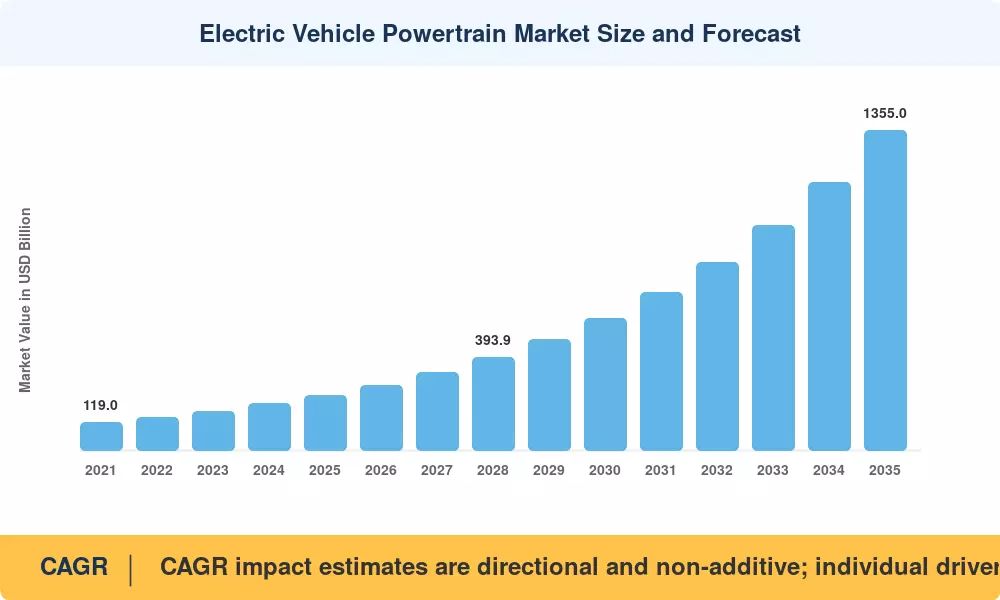
Electric Vehicle Powertrain Market to Reach USD 1,355.0 Billion by 2035, Growing at 19.3% CAGR
Electric Vehicle Powertrain Market
Battery electric vehicles (BEVs) commanded a 65.8% share of the Electric Vehicle Powertrain Market in 2025, outpacing plug-in hybrids by a widening margin.
NEW YORK, NY, UNITED STATES, August 27, 2026 /EINPresswire.com/ -- According to Market Research Future, the Electric Vehicle Powertrain Market is projected to grow from USD 276.8 billion in 2026 to USD 1,355.0 billion by 2035, registering a CAGR of 19.3% during the forecast period (2026–2035). This remarkable growth reflects the accelerating global transition toward electric mobility, where powertrain systems—comprising battery packs, electric motors, power electronics, and thermal management modules—are becoming the new heart of the automotive industry.Market Overview
Electric vehicle powertrains represent the complete system that converts electrical energy from the battery into mechanical energy to propel the vehicle. Unlike internal combustion engine powertrains, EV powertrains consist of fewer moving parts, offer higher efficiency, and enable regenerative braking capabilities. The market encompasses battery electric vehicles, plug-in hybrid electric vehicles, and fuel cell electric vehicles, each with distinct powertrain architectures and requirements.
The key growth drivers propelling this market expansion include stringent government emission regulations that are forcing automakers to accelerate electrification strategies. The increasing sales of electric vehicles due to government policies and incentives for curbing carbon footprint significantly boosts market growth . Battery cost compression is another critical driver, with volume-weighted average lithium-ion pack prices declining to USD 115/kWh, a substantial year-over-year reduction driven by falling lithium carbonate prices and manufacturing scale in China . The rising demand for hybrid electric vehicles in developed markets, including China, Germany, and the United States, is contributing to robust powertrain sales .
Technological developments are reshaping the powertrain landscape at an accelerating pace. Silicon-carbide MOSFETs are delivering efficiency improvements compared with traditional silicon IGBTs, translating into measurable range gains per kilowatt-hour of battery capacity . The EV Motor Market has seen significant innovation, with OEMs increasingly adopting design-to-cost methodologies for second-generation EVs, emphasizing lightweight materials and component integration to drive efficiency and performance improvements . The Battery Management System Market is closely intertwined with powertrain development, as advanced battery management becomes critical for optimizing performance, safety, and longevity.
The demand outlook for EV powertrains remains exceptionally strong. Passenger cars currently represent the largest segment, accounting for the highest volume of electric powertrain demand, driven by government regulations, financial incentives, and growing consumer adoption . The growing demand for electric light commercial vehicles for urban deliveries and last-mile logistics is driving the need for specialized powertrain solutions, with major companies like Amazon, FedEx, and DHL transitioning to electric delivery fleets .
📍 Get Free Sample Report for Detailed Market Insights:
https://www.marketresearchfuture.com/sample_request/8276
Market Segmentation
The electric vehicle powertrain market is segmented based on component, propulsion type, vehicle class, voltage architecture, and sales channel to provide comprehensive insights into the industry landscape.
By Component: The market is categorized into Battery Packs, Electric Motors, Power Electronics, Transmission/Reducer, and Thermal Management systems. Battery packs dominate the segment, driven by the growing adoption of larger battery packs in vehicles for higher ranges and more power . The electric motor segment is experiencing rapid innovation as manufacturers develop more efficient, compact, and lightweight motor designs. Power electronics, including inverters and converters, are critical for managing energy flow between the battery and motor. Thermal management systems are gaining importance as battery cooling and heating become essential for performance optimization and safety.
By Propulsion Type: The market covers Battery Electric Vehicles, Plug-in Hybrid Electric Vehicles, and Fuel Cell Electric Vehicles. BEVs represent the fastest-growing segment, driven by falling battery costs, expanding charging infrastructure, and zero-emission mandates . PHEVs continue to serve as a transition technology in regions with limited charging infrastructure, offering flexibility with dual-fuel capabilities . FCEVs, while representing a smaller segment currently, show promising potential in long-haul trucking and regions with established hydrogen supply chains.
By Vehicle Class: The market is divided into Passenger Cars, Light Commercial Vehicles, Heavy Commercial Vehicles, and Two/Three-Wheelers. Passenger cars dominate the market, driven by high production volumes and consumer demand for sustainable transportation . The electric two-wheeler and three-wheeler segment is growing rapidly in emerging markets due to lower operating costs and government incentives for electric scooters and motorcycles .
By Voltage Architecture: The market is segmented into ≤400 V Systems and 800 V Systems. 800 V architectures are gaining traction in premium and performance vehicles, enabling faster charging and improved efficiency. These systems reduce current for a given power level, allowing thinner wiring and reduced weight while enabling higher charging speeds.
By Sales Channel: The market is categorized into OEM-Fitted Powertrains and Aftermarket Retrofit. OEM-fitted applications dominate, with automakers integrating powertrain systems during vehicle production. The aftermarket retrofit segment is growing as existing vehicle owners and fleet operators seek to electrify conventional vehicles.
By Region: The market analysis covers North America, Europe, South America, Asia Pacific, and the Middle East and Africa.
🛒 You can buy this market report at:
https://www.marketresearchfuture.com/checkout?currency=one_user-USD&report_id=8276
Regional Analysis
Asia Pacific emerges as the dominant and fastest-growing regional market, driven by the region being the largest automotive manufacturing hub and the rapid adoption of electric vehicles across major economies. China leads the region with aggressive government initiatives promoting new energy vehicles and domestic production. The implementation of strict emission regulations such as BS-VI in India and China VI in China is driving the e-powertrain market in this region . India is proactively promoting electric vehicle adoption through initiatives such as the FAME-II, PM E-DRIVE, PLI Auto, PLI ACC Battery, and PM e-Bus Sewa schemes, which provide incentives for EV manufacturing, battery production, and vehicle purchases . Japan and South Korea are advancing automotive technologies through significant OEM investments and technology development programs.
North America represents a significant growth market, driven by strong government incentives, the continued expansion of domestic battery manufacturing, and stringent emission regulations. The United States benefits from the NEVI program deploying substantial funds to install public chargers by 2030, directly reducing range anxiety . Automakers are making strong investments in localizing supply chains to comply with regional trade agreements and secure tax incentives, leading to the construction of numerous gigafactories . Toyota Motor North America partnered with Cirba Solutions to solidify its electric vehicle battery recycling network, supporting a sustainable, closed-loop battery ecosystem .
Europe accounts for a significant market share, shaped by ambitious decarbonisation targets, stringent emission regulations, and strong OEM leadership. The region benefits from a strict regulatory push toward zero-emission transportation and pioneering circular economy initiatives, with intense focus on sustainable powertrain design and rare-earth-free synchronous motors . Germany launched a new electric vehicle subsidy portal providing financial support for low-income households purchasing eligible electric cars, encouraging wider EV adoption .
South America and the Middle East and Africa represent emerging markets with growing potential. Brazil is spearheading adoption in South America through the MOVER framework pairing tax relief with local-assembly incentives. The Middle East, particularly the UAE and Saudi Arabia, is showing increasing interest in electric mobility as part of smart city initiatives and sustainable transportation programs.
Competitive Landscape and Key Players
The electric vehicle powertrain market is highly competitive, featuring a mix of established automotive suppliers, technology specialists, and dedicated EV manufacturers. The competitive landscape is characterized by technological innovation, strategic partnerships, and supply chain investments.
Key players operating in this market include Robert Bosch GmbH, Continental AG, ZF Friedrichshafen AG, BorgWarner Inc., Magna International Inc., Mitsubishi Electric Corp, NXP Semiconductors, Tesla, BYD Company Ltd., and Rivian Automotive . These industry leaders are investing heavily in research and development to create advanced powertrain solutions that support various vehicle types and propulsion architectures.
Strategic developments are reshaping the competitive landscape. Continental AG's powertrain division, Vitesco Technologies, launched a new transmission control system featuring overmolded control electronics technology . Magna International expanded its powertrain business in Slovakia to develop powertrain metal forming solutions . OEMs, including Tesla, BYD, and Nio, are accelerating vertical integration, disrupting traditional supply chains and reshaping how value is captured across the ecosystem .
Innovation and technology initiatives are accelerating across the industry. Companies are developing modular powertrain platforms that support multiple vehicle architectures and propulsion types. The integration of AI-enabled diagnostics and predictive maintenance capabilities is becoming a competitive differentiator. Strategic collaborations between chip suppliers and automotive OEMs are strengthening end-to-end validation workflows and reducing integration risk.
Latest Industry News and Developments
Recent industry developments highlight the dynamic nature of the electric vehicle powertrain market. Major powertrain suppliers continue to expand their portfolios through new product launches and strategic investments. Companies are investing in modular and scalable powertrain platforms that support multiple vehicle architectures and propulsion requirements.
The growing adoption of 800 V architectures has prompted leading suppliers to develop advanced power electronics capable of handling higher voltages while reducing weight and improving efficiency. These developments are enabling faster charging capabilities and improved vehicle performance.
Technology demonstration projects continue to advance powertrain capabilities. Solid-state battery commercialization is progressing, with Toyota, Samsung SDI, and QuantumScape targeting pilot-line timelines for cells offering energy densities above 400 Wh/kg . Successful commercialization would reshape the EV powertrain market by enabling lighter, smaller battery packs that free up packaging space for vehicle designers.
Market Challenges and Opportunities
The electric vehicle powertrain market faces several key challenges that could impact growth trajectories. The high cost of battery components and necessary infrastructure remains a significant barrier. Essential materials like cobalt and lithium are sourced from limited geographical locations, leading to concerns over supply chain reliability and increased transportation expenses . Grid capacity constraints in many emerging markets could limit EV adoption without concurrent grid modernization investment .
Establishing a robust service network for after-sales of electric vehicles is vital for ensuring customer satisfaction and long-term retention. Unlike traditional vehicles, EVs require specialized knowledge and skills for maintenance and repairs due to their unique powertrain systems, software, and battery technologies .
Emerging opportunities are abundant in the evolving mobility landscape. Commercial fleet electrification in emerging markets represents significant growth potential, with India's FAME III scheme allocating funds toward electric two-wheelers, three-wheelers, and light commercial vehicles . Vehicle-to-grid and bidirectional charging services create recurring revenue streams for EV owners through exported energy back to the grid during peak demand periods .
Technology-driven possibilities are expanding rapidly with solid-state battery commercialization, silicon carbide power semiconductor adoption, and advanced thermal management solutions. The development of lightweight materials and integrated powertrain components is reducing manufacturing costs while enhancing vehicle performance .
Future growth potential remains exceptionally strong, driven by the accelerating transition to sustainable mobility and the increasing competitiveness of electric vehicles across performance and cost metrics. As battery technology continues to advance, charging infrastructure expands, and government policies remain supportive, electric vehicles will become increasingly mainstream across global markets. Manufacturers that embrace innovation, build resilient supply chains, and develop compelling product portfolios will capture value in the rapidly evolving electric powertrain ecosystem.
To explore more market insights, visit us at:
https://www.marketresearchfuture.com/reports/electric-vehicle-powertrain-market-8276
Final Market Summary
The electric vehicle powertrain market is poised for extraordinary growth, driven by technological advancement, regulatory support, and shifting consumer preferences toward sustainable mobility. The market's trajectory from USD 276.8 billion in 2026 to USD 1,355.0 billion by 2035 reflects the fundamental transformation of the automotive industry from internal combustion engines to electric propulsion.
The long-term industry potential remains exceptionally bright, with advancements in battery chemistry, motor efficiency, power electronics, and thermal management continuing to expand the addressable market. The convergence of EV powertrains with broader mobility ecosystems, including renewable energy integration, vehicle-to-grid services, and autonomous driving platforms, is creating comprehensive solutions that serve diverse customer needs.
Key factors expected to influence future development include the pace of battery cost decline, advancements in solid-state and silicon carbide technologies, and the evolution of regulatory frameworks. The development of resilient supply chains for critical minerals will address availability concerns and accelerate market growth. Investments in localized production, innovative business models, and digital integration will enable manufacturers to meet the evolving demands of global consumers.
The transformation from internal combustion engine powertrains to electric drivetrains represents a fundamental industry evolution, positioning EV powertrains as essential components of the sustainable mobility ecosystem. As battery technology matures, costs decline, and infrastructure expands, electric vehicles will become increasingly common across all vehicle segments, ensuring sustained innovation and growth throughout the forecast period and beyond.
More Related Reports from MRFR Library:
Electric Boat and Ship Market : https://www.marketresearchfuture.com/reports/electric-boat-ship-market-42078
Corporate Employee Transportation Service Market : https://www.marketresearchfuture.com/reports/corporate-employee-transportation-service-market-42085
Municipal Vehicle Market : https://www.marketresearchfuture.com/reports/municipal-vehicle-market-42193
Automotive Data Monetization Market : https://www.marketresearchfuture.com/reports/automotive-data-monetization-market-42863
Europe Railroads Market : https://www.marketresearchfuture.com/reports/europe-railroads-market-44104
Germany Electric Vehicle Charging Station Market : https://www.marketresearchfuture.com/reports/germany-electric-vehicle-charging-station-market-44108
India Electric Vehicle Charging Station Market : https://www.marketresearchfuture.com/reports/india-electric-vehicle-charging-station-market-44113
Europe Motorcycles Market : https://www.marketresearchfuture.com/reports/europe-motorcycles-market-44791
UK Automotive Aftermarket Market : https://www.marketresearchfuture.com/reports/uk-automotive-aftermarket-industry-44796
Japan Automotive Aftermarket : https://www.marketresearchfuture.com/reports/japan-automotive-aftermarket-industry-44798
Market Research Future
Market Research Future
+1 855-661-4441
email us here
Legal Disclaimer:
EIN Presswire provides this news content "as is" without warranty of any kind. We do not accept any responsibility or liability for the accuracy, content, images, videos, licenses, completeness, legality, or reliability of the information contained in this article. If you have any complaints or copyright issues related to this article, kindly contact the author above.
